Snooker Re-Rack Explained: When It Happens, Who Calls It, and What to Do
What Is a Re-Rack in Snooker?
A re-rack in snooker means the balls are cleared from the table and set up again exactly as they were at the start of the frame, all 15 reds in the triangle, all six colours on their spots, and the cue ball in hand behind the baulk line. The frame effectively restarts from scratch, with no points carried over from the aborted attempt. It is a legitimate part of the game with specific rules governing when it can happen, who has the authority to call one, and how the procedure is carried out.
Most club players rarely encounter a re-rack, but when one is needed, confusion often follows. Understanding the rules properly saves arguments at the table and keeps the game moving.
When Can a Re-Rack Be Called?
The World Snooker rulebook specifies that a re-rack can only happen under certain defined circumstances. It is not something either player can demand simply because they are unhappy with the run of play or feel the position has become difficult. There are two main situations where a re-rack becomes an option.
Agreement Between Both Players
The most straightforward route to a re-rack is by mutual consent. If both players agree that the frame has reached a position where meaningful snooker is no longer possible, or where continuing serves no real purpose, they can jointly decide to re-rack. This requires both players to be in agreement. One player cannot force a re-rack unilaterally just by asking for one; the other player must consent.
In practice, this situation tends to arise when the score is very close, relatively few balls remain on the table, and both players feel the position has become too defensive or too locked down to produce a fair contest. It can also happen when an unusual situation, a badly pocketed ball that somehow returned to the table, for instance, leaves the frame in a state neither player considers reasonable to continue from.
The Referee’s Authority
A referee can call a re-rack without either player requesting it, but only in specific circumstances. The main trigger is when a frame has reached a stage that the referee judges to be unresolvable by normal play. The classic example is a position where neither player can make any legal shot without conceding points, or where the game has effectively stalled with no prospect of progress.
In practice, referees at the professional level will also consider a re-rack if balls are irrecoverably jammed, wedged against each other or against a cushion in a way that makes normal play impossible, though this is extremely rare with well-maintained equipment and balls. See our guide to snooker balls for more on equipment standards that help prevent these situations.
The Stalemate Rule
This is where the re-rack rule has the most teeth. If both players repeatedly play the cue ball into baulk, essentially using the cushions at the baulk end to avoid engaging with the reds, without making any genuine attempt to pot a ball or disturb the pack, the referee can intervene. Under the rules, the referee will give a warning after a set number of such shots, and if the behaviour continues, a re-rack can be ordered.
This situation is sometimes called a snooker stalemate, and it is more common at the professional level than you might think, particularly in frames where one player is heavily in front and trying to run the clock, or where both players are locked in a defensive battle over a solitary red near baulk. The rules are designed to keep the game moving and prevent deliberate time-wasting from becoming a winning strategy.
Who Calls the Re-Rack?
At professional level, the referee makes the call, either in response to a mutual request from both players or on their own initiative when the conditions warrant it. The referee’s decision is final in these matters. Neither player can override it once the referee has determined that a re-rack is the correct outcome.
In amateur and club play where there is no dedicated referee, the situation is simpler: both players must agree. If one player wants a re-rack and the other does not, no re-rack happens. The frame continues. This is an important point because disputes arise when one player assumes they can demand a re-rack and becomes frustrated when the other refuses.
In competition play at club or amateur level, check the specific tournament rules before the event. Some competitions have a designated referee or tournament director who can adjudicate disputes, including re-rack decisions. If neither player agrees and there is no official present, the frame must continue under whatever awkward conditions exist.
The Procedure for a Re-Rack
Once a re-rack has been agreed or called, the procedure is straightforward but must be followed correctly to be valid.
Clearing the Table
All balls are removed from the table, every red, every colour, and the cue ball. Any balls that have already been potted and are sitting in the pockets or ball channels are also collected. The entire set of balls returns to the table for the re-spot.
Re-Spotting the Colours
Each colour goes back on its designated spot: yellow on the right of the brown from the baulk end (also described as the right-hand corner of the D, from the player’s perspective when breaking off), green on the left, brown in the centre of the baulk line, blue in the middle of the table, pink just above the triangle of reds, and black on the spot near the top cushion. If a spot is occupied during normal play, there are rules about where to place the ball, but for a re-rack, all spots should be clear, so each colour goes exactly where it belongs.
Re-Racking the Reds
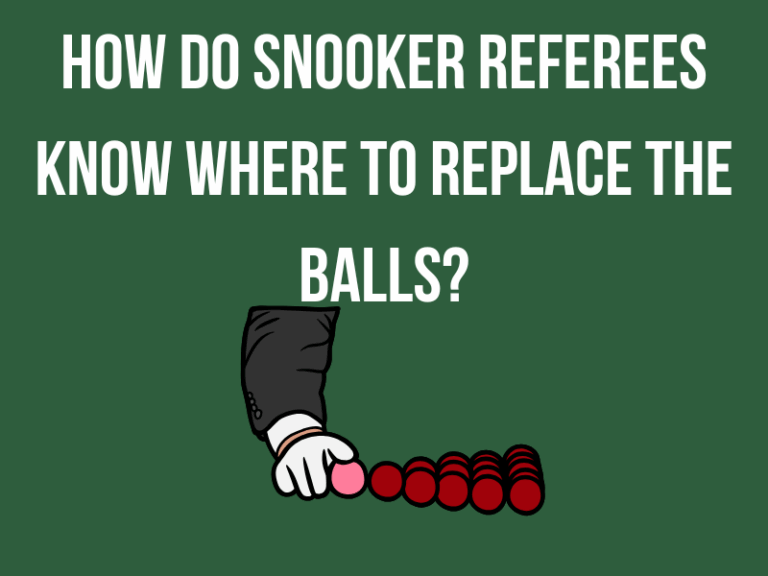
The 15 red balls are placed back in the triangle with the apex ball as close as possible to the pink without touching it. In practice, this means the front red sits approximately 27cm from the pink. The triangle must be tight, no gaps between reds, and the apex points towards the top cushion, with the base of the triangle facing the baulk end. The rack is removed carefully once the reds are set to avoid disturbing the formation.
Cue Ball in Hand
The player who breaks off in the re-rack plays with the cue ball in hand from within the D, the semicircular area at the baulk end of the table. In most cases, the same player who broke off the original frame retains the break-off in the re-rack. This is the standard rule, though some competition formats specify otherwise, so always check the relevant ruleset.
At professional level, the referee confirms who breaks and announces the re-rack clearly before leaving the players to begin. In amateur play, both players should confirm the break-off order before the new frame begins to avoid any dispute after the fact.
Scores Are Reset
This is the detail that catches some players out. All scores from the aborted frame are wiped. No points carry over. If one player had built a 40-point lead before the re-rack, that lead is gone. The frame starts at 0-0. This is why a player in a strong scoring position will sometimes resist a mutual re-rack even if the table position is tricky, they stand to lose a meaningful advantage.
Common Misconceptions and Mistakes
Several misunderstandings regularly come up around re-racks, particularly in club play.
Confusing a Re-Rack with a Free Ball
Some players confuse re-rack situations with the free ball rule. A free ball is awarded after a foul leaves the incoming player snookered on all reds, it is a specific remedy for a specific situation and has nothing to do with a re-rack. The two rules are completely separate. A free ball does not reset the frame; a re-rack does.
Assuming a Re-Rack Can Be Claimed at Any Time
A player cannot call a re-rack simply because they are losing badly or because the position feels hopeless for them. The rules require either mutual consent or a referee’s determination that the frame has stalled. A player trailing by 60 points with six reds still on the table has no grounds to demand a re-rack, the game must continue.
Getting the Colours Wrong After Re-Racking
In casual play, re-racks are rare enough that players sometimes forget exactly where each colour belongs. The most commonly misplaced balls are the yellow and green, players occasionally swap them. Yellow sits on the right-hand side of the D (from the breaking player’s viewpoint), green on the left, brown in the centre. Getting this wrong in a competitive match is an avoidable error that wastes time and can cause unnecessary disputes.
Carrying Over the Break-Off Player Incorrectly
The player who originally broke off should re-break in most standard formats. However, in some competitions, particularly team events or certain handicap formats, there may be specific rules about re-rack break-offs. Check the small print. Assuming the wrong player breaks off can lead to a foul before a single shot has been played in the new frame.
Re-Racks in Professional Snooker
Re-racks at the professional level are infrequent but not unheard of. They tend to occur in tight frames during defensive exchanges, particularly in sessions where both players are operating at a high level and neither wants to concede easy access to the reds. When a professional match does reach a re-rack, it is generally after a prolonged safety battle has left the balls in a position that the referee deems genuinely unplayable or after both players have visibly been playing into baulk repeatedly without intent to pot.
Referees at the top level are experienced enough to manage these situations decisively. They will issue a verbal warning, often audible to viewers watching at home, before ordering the re-rack, giving both players the opportunity to change their approach. If the defensive play continues, the re-rack follows. Choosing the right equipment matters at every level; a quality snooker cue gives you the control and touch needed to play legitimate safety shots rather than resorting to the kind of aimless baulk-rolling that risks a referee’s intervention.
Drills and Habits That Help You Avoid Re-Rack Situations
The best way to avoid a re-rack called against you for stalling is to develop a genuine safety game, one that creates opportunities rather than simply dodging confrontation. Work on controlled safety play that consistently leaves the cue ball tight to the baulk cushion while moving the object ball to an awkward position. This satisfies the requirement to play a genuine shot and keeps you within the rules.
A useful practice drill is to place a red near the pink spot and repeatedly play a shot that leaves the cue ball in baulk while sending the red to a designated position. This trains the habit of purposeful safety play rather than aimless defensive shots. If you can demonstrate intent, moving the red, creating a genuine snooker, or disturbing the formation, you are playing legitimate snooker, and no referee will have grounds to call a re-rack on you.
Frequently Asked Questions
Can a player refuse a re-rack in snooker?
Yes, in amateur and club play where there is no referee, a player can refuse a re-rack if the other player requests one. Both players must agree for a mutual re-rack to proceed. The only situation where a re-rack can happen over one player’s objection is when a qualified referee determines it is necessary, for example, in a recognised stalemate situation. Without a referee present, if one player refuses, the frame must continue.
Do points scored before a re-rack count?
No. A re-rack completely resets the frame. Any points scored before the re-rack are wiped, and both players start again from zero. This applies to match formats as well, the frame that is re-racked does not count as a frame win for either player. It is simply replayed from the beginning as if it had never started.
What happens if the colours are spotted incorrectly after a re-rack?
If a colour is placed on the wrong spot before play resumes and a shot is played, the incorrectly placed ball is treated as a ball on its wrong spot, which can create foul situations depending on what is subsequently potted or struck. The safest course of action is for both players to verify the positions of all six colours before breaking off after a re-rack. If spotted incorrectly and the error is caught before any shot is played, simply correct it. In a refereed match, the referee handles the re-spot and is responsible for accuracy.