
Torbjörn Blomdahl
Torbjörn Blomdahl is one of the most decorated and recognizable names in carom billiards, a Swedish player whose dominance in three-cushion over several decades placed him firmly among the all-time greats of the discipline. With a technical precision that borders on mechanical and a competitive…
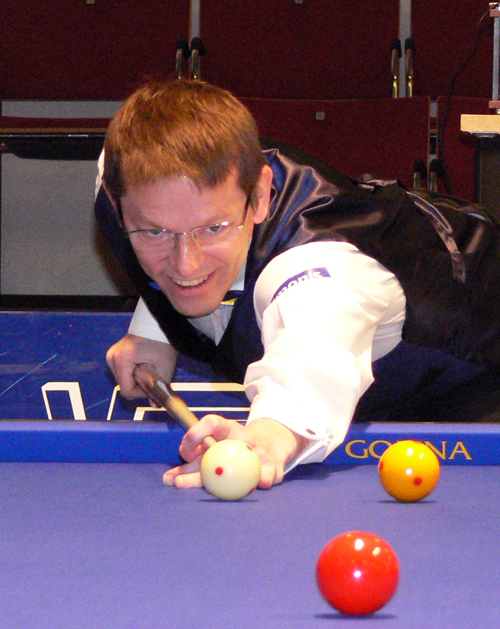 Wikimedia Commons, CC BY-SA
Torbjörn Blomdahl at a Glance
- Nationality – Swedish
- Born – 17 August 1962
- Turned Professional – 1980s
- World 3-Cushion Championships – 7 (1988, 1990, 1994, 1996, 1998, 2000, 2002)
- Known For – Most successful European 3-cushion carom billiards player
Early Life and Introduction to Billiards
Blomdahl grew up in Sweden at a time when billiards culture in Scandinavia, while not as embedded in daily life as it was in Belgium or the Netherlands, still had devoted clubs and a passionate community. He took up three-cushion billiards as a young man and quickly distinguished himself through an aptitude for the geometric demands of the game. Unlike pool or snooker, three-cushion carom requires a player to contact at least three cushions with the cue ball before completing a valid carom, and there is no pocket to aim for. The game rewards players who can visualize complex angles and control speed with surgical precision. Blomdahl, from his earliest years as a competitive player, showed he could do both.
Sweden produced other capable billiards players, but Blomdahl operated at a level that made him stand apart almost immediately once he entered international competition. His development came through rigorous practice and serious engagement with the European club circuit, where three-cushion has long been a staple of competitive billiards. By the time he reached the top tier of UMB-sanctioned competition, he was already showing the hallmarks of a player who would define the era.
Career Highlights
Blomdahl’s career at the World Three-Cushion Championship, governed by the Union Mondiale de Billard, is the centrepiece of his legacy. He won the world title multiple times across his career, with victories spread over a long span that testified to his consistency and adaptability. Winning a world championship in three-cushion once is a significant achievement. Winning it multiple times, across different decades, against evolving fields of competitors that included Belgian, Dutch, Korean, and Turkish players of the highest calibre, places Blomdahl in rarefied company.
Among his most notable rivals during his peak years were players like Raymond Ceulemans, the Belgian legend who dominated the sport before Blomdahl’s rise, and later challengers from the growing Asian three-cushion scene, particularly from South Korea and Turkey, which transformed the competitive landscape from the 1990s onward. Blomdahl navigated all of these eras with distinction. He adapted his game as competition intensified, remaining a consistent finalist and champion long after many players his age had stepped back from the top level.
Beyond world championship titles, Blomdahl accumulated an extensive record at European level and in invitational and tour events. He represented Sweden across team competitions and helped elevate the profile of three-cushion in a country that was not traditionally a stronghold for the discipline. His longevity at the elite level is arguably as impressive as any individual title, given that three-cushion physically and mentally taxes its players at every match.
Blomdahl also made a significant contribution to the sport through his visibility in televised events and international tours. As three-cushion worked to reach broader audiences, particularly in Europe and Asia, having a world-class player with Blomdahl’s charisma and track record helped legitimize the discipline to new fans. His matches, often broadcast in Belgium and the Netherlands where billiards commands genuine mainstream attention, drew large audiences and introduced many viewers to the beauty of high-level carom play.
Playing Style
Three-cushion demands that players master several fundamental families of shots: the direct attack, the indirect long-angle approach, the short-angle system play, and the highly specialized nurse and series techniques. Blomdahl built his game around a comprehensive command of all of these, with particular strength in the systematic approaches that allow a player to solve a table position through calculated geometry rather than improvisation.
His cueing action is clean and economical. There is nothing theatrical or excessive about the way Blomdahl addresses the ball. The stroke is compact, smooth, and repeatable, which in three-cushion is as important as raw power. Because carom billiards is played on a larger table surface than most pool formats, controlling the speed and spin of the cue ball across the full length of a carom table requires exceptional touch. Blomdahl’s touch throughout his career has been widely praised by analysts and commentators as among the finest the sport has produced.
His system play is especially noteworthy. Three-cushion players at the elite level use mathematical diamond systems to calculate where the cue ball will travel after multiple cushion contacts. Blomdahl’s ability to apply and adapt these systems under match pressure, when nerves and time constraints can distort judgment, set him apart from competitors who had equal technical ability in practice but faltered in tournaments. He also showed a strong strategic mind in terms of safety and position play, understanding that leaving an opponent in a difficult position is as valuable in three-cushion as making the point itself.
His cue selection and maintenance have always reflected his methodical approach to the game. Blomdahl is known for being precise and deliberate in his equipment choices, understanding that in carom billiards, where tip condition and ferrule response directly affect how spin translates to the cue ball, every detail of the equipment matters. Players at this level do not leave such things to chance, and Blomdahl exemplifies that professional attention to the tools of the trade.
What also distinguishes Blomdahl is his temperament. Three-cushion matches at world level can be long, grinding affairs where a single missed point can shift momentum dramatically. Blomdahl’s demeanour at the table, patient, focused, and without obvious emotional swings, gave him a psychological edge against opponents who let frustration or excitement disrupt their concentration. This mental stability is a defining quality of the greatest carom players, and Blomdahl has exhibited it consistently throughout his career.
Legacy and Influence
Blomdahl’s influence on three-cushion extends well beyond his own trophy cabinet. He became an ambassador for the sport at a time when carom billiards needed visible, compelling champions to hold its ground against snooker and pool for international attention. His willingness to compete globally, travelling to events in Asia and the Americas as well as across Europe, demonstrated a professionalism and competitiveness that helped define standards for the modern era of three-cushion.
Younger players who came up through European and Asian carom programs in the 1990s and 2000s grew up watching Blomdahl compete. His style, methodical, consistent, and technically impeccable, provided a model that coaches and players could study. The explosion of interest in three-cushion, particularly in Turkey and South Korea, created a new generation of elite players who eventually challenged and at times surpassed the European establishment, but those players developed against a benchmark that Blomdahl had done much to establish.
For fans who want to follow in the footsteps of players like Blomdahl at home, the equipment side of the game matters considerably. The choice of cue tip alone can significantly affect how spin and speed are transmitted in carom play, and enthusiasts who take the game seriously invest considerable thought into this aspect of their setup, just as the professionals do.
Blomdahl remains one of the definitive figures in three-cushion billiards history. His record stands as evidence of what sustained dedication, technical development, and competitive hunger can produce over a long career in one of the most demanding cue sports disciplines in the world.
Frequently Asked Questions
What discipline does Torbjörn Blomdahl compete in?
Blomdahl competes in three-cushion carom billiards, a pocket-less cue sport played on a large table where the cue ball must contact at least three cushions before completing a valid carom. It is one of the most technically demanding disciplines in all of cue sports.
How many World Three-Cushion Championship titles has Blomdahl won?
Blomdahl has won the UMB World Three-Cushion Championship multiple times across his career. He is widely regarded as one of the most successful players in the history of the event, though precise title counts should be verified against the UMB’s official records for exact figures.
What makes three-cushion billiards different from pool or snooker?
Three-cushion is a carom discipline with no pockets. A point is scored only when the cue ball contacts the two object balls and at least three cushions in a single shot, requiring a level of geometric and speed calculation that differs fundamentally from pocket billiards formats.
Who were Blomdahl’s main rivals during his peak years?
Blomdahl competed against a range of elite players including Raymond Ceulemans of Belgium, one of the sport’s all-time legends, as well as top rivals from the Netherlands, Turkey, and South Korea as those nations developed increasingly powerful three-cushion programs. The competitive field he navigated across decades was exceptionally strong.
Is Torbjörn Blomdahl still active in competitive billiards?
Blomdahl remained active in competitive three-cushion billiards well into the later stages of his career, continuing to compete at high levels long after many peers had retired. For his current competitive status, checking the latest UMB rankings and tournament entries will give the most accurate picture.