
Dennis Orcollo
Dennis Orcollo is not a product of academies, coaching programs, or structured development pathways. He is the product of a grandfather’s pool table, survival instincts sharpened before adolescence, and a rare mechanical precision that earned him the nickname RoboCop. Born January 28, 1979, in…
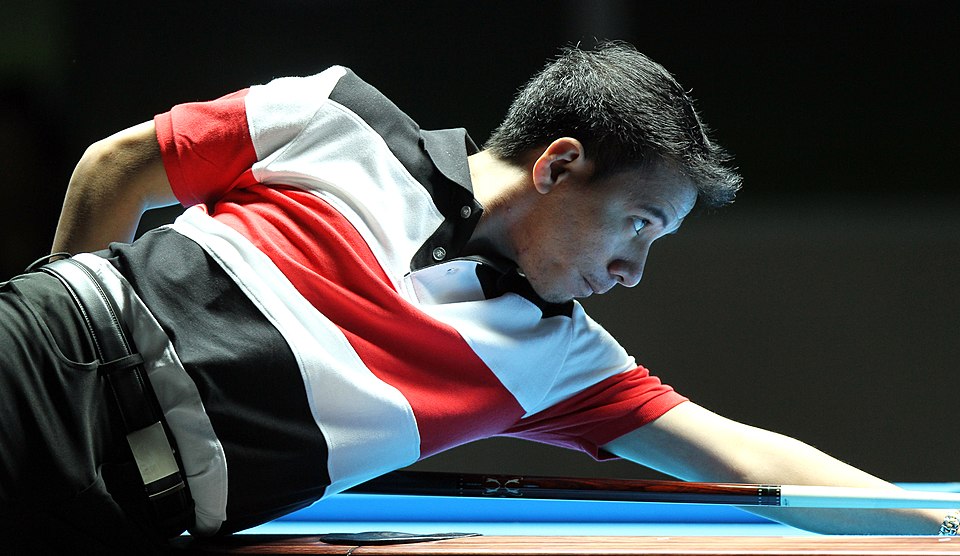 Wikimedia Commons, CC BY-SA
Dennis Orcollo at a Glance
- Nationality – Filipino
- Born – January 28, 1979, Surigao del Sur, Philippines
- Nicknames – RoboCop, Surigao, The Philippines’ Money-Game King
- Turned Professional – Mid-1990s
- Notable Titles – 2011 WPA World 8-Ball Championship, 2009 BCA U.S. Open (9-Ball), Three-time Derby City Master of the Table (2014, 2017, 2020)
Early Life
Orcollo’s father worked as a fisherman, and the family’s financial circumstances were severe enough that Dennis dropped out of school at age nine. By that point he had already been playing pool for roughly a year, gravitating toward his grandfather’s table as both recreation and income. He was running racks and beating grown men for 20 pesos a game before most kids his age were thinking about anything beyond homework.
That environment, grinding for small stakes against adults who had no interest in going easy on a child, forged something exceptional. Orcollo was not mentored into the sport. He competed his way into it, developing shot-making instincts through necessity rather than instruction. The province of Surigao gave him his first nickname. The precision that followed gave him the second.
The Philippines has produced a staggering number of elite pool players relative to its population, and the culture of billiards in the country runs deep. Pool halls function as social institutions. Hustling is not stigmatized but respected when it reflects genuine ability. Orcollo fit that culture perfectly and eventually outgrew it, taking his game to international stages where the stakes were far higher than 20 pesos.
Career Highlights
Orcollo’s competitive record is built on two pillars: formal world-stage victories and an underground money-game reputation that may actually exceed his trophy count in terms of influence. He has been called the Philippines’ Money-Game King, a title that in pool circles carries genuine weight. Money matches attract the best players in the world precisely because the format demands sustained excellence under direct financial pressure.
On the formal circuit, his signature achievement came in 2011 when he won the WPA World 8-Ball Championship in Fujairah, UAE, defeating a field that included some of the sport’s top-ranked competitors. The title confirmed what money-game players and action rooms already knew: Orcollo’s precision under pressure was not a rumor. It was documented.
The 2009 BCA U.S. Open 9-Ball Championship added another major title to his record. The U.S. Open is one of the most prestigious events in American pool, drawing an international field, and winning it placed Orcollo firmly in the conversation about the sport’s elite. Between those two headline results sits a pattern of deep runs, high finishes, and WPA medal-level performances across multiple disciplines and formats.
Derby City Classic, held annually in Kentucky, is an event where reputation gets tested across multiple disciplines: one-pocket, 9-ball, 8-ball, and banks. Orcollo won the overall Master of the Table title there in 2014, 2017, and 2020, three times, a feat that speaks to genuine all-around command of the sport rather than narrow specialization. Winning once at Derby City signals ability. Winning it three times in different years signals something closer to dominance.
His Fargo Rating, the statistical system used to rank players based on match performance, placed him second in the world at 811.5 at the time of one notable snapshot, trailing only Shane Van Boening of the United States. For context, the Fargo system is built on thousands of head-to-head results and is considered one of the most reliable objective ranking tools in competitive pool. Sitting at number two on that list is not a matter of opinion.
He was inducted into the Billiard Congress of America Hall of Fame, recognized specifically for his shot-making precision and his collection of major titles. He has also been honored as a two-time Filipino Athlete of the Year, recognition that carries real cultural significance in a country where boxing and basketball dominate the sports conversation. That pool could produce a two-time national athlete of the year speaks to both the sport’s Philippine roots and Orcollo’s standing within them.
Playing Style
The nickname RoboCop is not ironic. Orcollo’s approach at the table is methodical, controlled, and almost unsettlingly consistent. His shot-making is clean, his decision-making under pressure is sound, and his cue ball control is the kind that comes from decades of repetition starting in childhood. Players who have faced him in money games describe a quality that is difficult to quantify but immediately felt: he does not appear rattled.
His game covers multiple formats, which is rarer than it sounds at the highest level. Many elite players sharpen into specialists, becoming exceptional at one game while remaining merely good at others. Orcollo’s Derby City record demonstrates genuine fluency across disciplines. One-pocket in particular rewards patience, positional thinking, and the ability to read the table several moves ahead. His success in that format, combined with his 8-ball and 9-ball credentials, identifies him as a complete player rather than a one-format specialist.
In terms of equipment, Orcollo has been associated with Dennis Orcollo signature cue models over the years, with players at his level typically investing in precisely matched cue tips to maintain the exact feel and feedback they’ve built their stroke around. The mechanical consistency of his game reflects the kind of attention to equipment detail that separates elite competitors from merely talented ones.
His money-game reputation also reflects something stylistic. In action pool, you cannot hide. There are no brackets to survive, no format irregularities to exploit, no off-days absorbed by a long event. You perform or you lose money. Orcollo’s sustained success in that arena over many years is its own form of statistical evidence about the reliability of his game.
Legacy and Impact
Philippine pool has an astonishing roll call: Efren Reyes, Francisco Bustamante, Django Bustamante, Carlo Biado, and Orcollo among others. The country has produced more world-class pool players per capita than virtually any other nation, and Orcollo occupies a specific place in that tradition as someone who came from genuinely difficult circumstances and competed his way to the top without shortcuts or institutional support.
His two Filipino Athlete of the Year honors put him in mainstream national sports recognition alongside athletes from higher-profile disciplines. That kind of visibility matters for pool in a country where the sport is beloved at street level but not always recognized at the level of formal athletic achievement.
For younger Filipino players looking at what a complete career in international pool looks like, Orcollo’s record provides a clear template. World title. Major championship victory. Money-game credibility. Hall of Fame recognition. Sustained performance across formats and decades. Whether those players are working on a table in Manila or following results from abroad, the equipment they practice on matters too. Anyone serious about developing their game would benefit from understanding how to maintain a proper setup, down to researching quality pool tables that hold their cloth and cushion response over years of heavy use.
Orcollo’s longevity in the sport also deserves recognition. He turned professional in an era before streaming, social media, and the current wave of pool’s global audience growth. He built his reputation the hard way, match by match, across decades. The fact that his Fargo Rating had him ranked second in the world after all those years is not a beginning-of-career data point. It reflects sustained excellence across a long arc.
Frequently Asked Questions
Why is Dennis Orcollo called RoboCop?
The nickname reflects his mechanical, precise, and emotionally controlled style at the table. Opponents and fans alike noticed that his shot-making under pressure had an almost automated quality that earned the comparison.
What is Dennis Orcollo’s most significant world title?
His 2011 WPA World 8-Ball Championship, won in Fujairah, UAE, is his most prominent formal world title. He also won the 2009 BCA U.S. Open 9-Ball Championship, one of American pool’s most prestigious events.
How many times did Dennis Orcollo win the Derby City Master of the Table?
Orcollo won the Derby City Classic Master of the Table all-around title three times, in 2014, 2017, and 2020. This multi-discipline honor is widely considered one of the most demanding achievements in American pool.
Has Dennis Orcollo been inducted into the Billiard Congress of America Hall of Fame?
Yes. Orcollo was inducted into the BCA Hall of Fame as a player, recognized for his precise shot-making, multiple WPA medals, and victories in major international events.
What is Dennis Orcollo’s connection to money-game pool?
Orcollo is widely regarded as the Philippines’ Money-Game King, a reputation built over decades of high-stakes action matches played outside formal tournament brackets. His success in that arena is considered by many in the sport to be as impressive as his tournament record.