
Darren Appleton
Darren “Dynamite” Appleton is one of the most decorated pool players of the modern era, a man who crossed over from English pool into the international game and proceeded to win world titles across multiple disciplines. Born in England and carrying the same precision-minded grit that defines his…
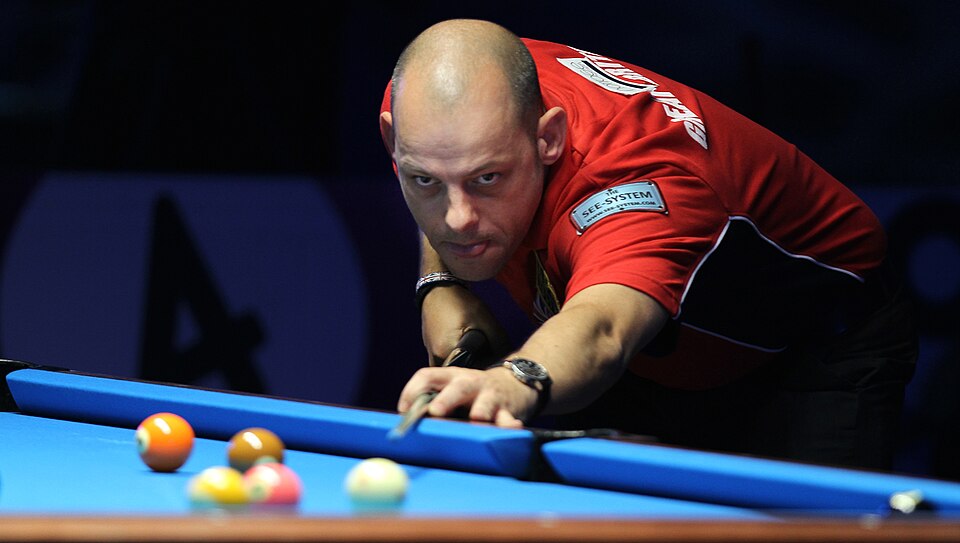 Wikimedia Commons, CC BY-SA
Darren Appleton at a Glance
- Nationality – English
- Born – 2 June 1978
- Nickname – Dynamite
- Turned Professional – Late 1990s
- World Pool Championship – 2010
- US Open 9-Ball Championship – 2011
Early Life and Background
Appleton grew up in England steeped in the local pool culture that shaped a generation of British cue sports players. Like many English players of his era, he came up through the eight-ball scene, learning the fundamentals on the smaller tables and tighter pockets that demand a precise touch. He was never far from snooker either, given that the sport is practically ambient in British life, but he never pursued it professionally. The reason was simple and practical: snooker demanded a six-to-seven-hour daily training commitment with relatively few tournament opportunities available to young players at the time. Pool offered a faster path to competition, and Appleton took it.
That early decision shaped everything. Rather than grinding through the snooker ranking system, Appleton developed a versatile cue game on the pool table, one that would eventually transfer with remarkable effectiveness to the international nine-ball and ten-ball circuits where he would make his name. His roots in English pool gave him a safety game and positional discipline that players who came up purely on the American-style open tables sometimes lacked.
Career Highlights
Appleton announced himself on the world stage in 2008 by winning the inaugural WPA World Ten-ball Championship, defeating Wu Jia-qing of Taiwan in the final. Wu was no ordinary opponent, having already been a world champion in both nine-ball and eight-ball, so the victory carried genuine weight. Winning the first-ever edition of a world championship is a result that stays on the record permanently, and Appleton made sure the moment counted.
From there, Appleton kept stacking titles. He became a two-time champion at the U.S. Open 9-Ball Championship, one of the most grueling and prestigious events on the American pool calendar, where the field is stacked with top American professionals who treat a home loss as a personal affront. Winning it once is an achievement. Winning it twice marks a player as genuinely elite.
His Mosconi Cup record stands as one of the defining statistics of his career. A seven-time winner representing Team Europe in the annual Ryder Cup-style showdown against Team USA, Appleton thrived in the pressure-cooker match-play format where the crowd noise, team dynamics, and single-session stakes amplify every shot. The Mosconi Cup separates players who perform in quiet tournament halls from those who can deliver when an arena full of partisan fans is watching every safety attempt and every runout.
In 2014, Appleton demonstrated his straight pool credentials by winning the Dragon 14.1 Tournament, beating Shane Van Boening in the final. Van Boening is arguably the best American player of his generation, so defeating him in a 14.1 straight pool format, a discipline requiring patience and long-range planning over a short-burst tactical game, reinforced that Appleton’s skills were not confined to any single format. That same year he and Karl Boyes won the World Cup of Pool together, representing Team England and adding a team title to his growing individual collection.
In February 2015, Appleton won the WPA World Chinese Eight-ball Championship, defeating snooker world champion Mark Selby 21-19 in the final to become the inaugural champion of that discipline. Selby is one of the most technically complete safety players in any cue sport, making that margin of victory all the more impressive. Appleton had now won the first-ever edition of two separate world championships, a distinction very few players in any sport can claim.
The titles kept coming. In 2017, Appleton won the Super Billiards Expo One-Pocket Division, a format built on strategy, ball control, and the ability to think several shots ahead without the safety net of a forgiving layout. Most recently, he won the 2024 Ultimate Pool Louisiana Shootout, defeating Roberto Gomez in the final to claim yet another inaugural title, confirming that his competitive edge has not dulled with age.
The BCA Hall of Fame induction in 2017 was recognition from the American pool establishment that Appleton had done something genuinely lasting for the sport. Hall of Fame selections are often politically complex affairs, but in Appleton’s case the title list made the argument for him.
Playing Style
Appleton is a complete player in the truest sense. His positional play is precise without being mechanical, his safety game carries the patience his English pool background installed early, and his shot-making under pressure is what separated him during his peak Mosconi Cup years. He is not a one-format player, which is the most telling thing about his game. Players who win world titles across ten-ball, nine-ball, straight pool, one-pocket, and Chinese eight-ball are not relying on one specific skill. They are reading every rack, every table, and every opponent differently.
His approach to equipment reflects the same attention to detail. The cue tip and chalk choices that professionals at Appleton’s level make are not casual decisions. Players competing across different table surfaces and ball sets need equipment that performs consistently. Fans interested in understanding those choices can start with a look at quality cue tips, one of the variables that most directly affects how a player transfers pace, spin, and precision to the cue ball.
What stands out in match footage is Appleton’s tempo. He does not rush, and he does not stall. His pre-shot routine is consistent, and he approaches each ball in a rack with the same physical process regardless of the scoreline. That kind of mental discipline under match pressure is something that cannot be coached into a player easily. It is either built through years of high-stakes competition or it is not there at all. For Appleton, it has clearly been built.
His decision-making in one-pocket and straight pool formats reveals a strategic depth that pure action players often lack. Those disciplines penalize impatience, and Appleton’s willingness to take the longer, safer path to victory rather than forcing a flashy shot speaks to a competitive maturity that developed well before his Hall of Fame plaque was cast.
Legacy and Place in the Game
What separates Appleton from many of his contemporaries is the breadth of his record. Many top professionals build their careers around one format, one region, or one style of table. Appleton built his around whatever the game demanded, adapting and winning. Four world titles, two U.S. Open victories, seven Mosconi Cup wins, inaugural championships in two separate world championship events, a Hall of Fame induction, and continued competitive results into his late 40s constitute a resume that holds up against anyone in the history of international pool.
He has also served as a visible representative of British pool on the world stage during a period when the American and Asian circuits dominated the headlines. His success opened doors and raised expectations for the players who came after him from that part of the world. That kind of influence is harder to quantify than a trophy count, but it is real.
Appleton’s career is not finished. The 2024 Louisiana Shootout win showed he is still competing and still winning at the highest level. Whatever comes next, “Dynamite” has already secured his place among the most accomplished pool players the sport has produced.
Frequently Asked Questions
What is Darren Appleton’s nickname?
Darren Appleton is known as “Dynamite,” a nickname that has followed him throughout his international career and reflects his aggressive, high-energy approach to competition.
How many world titles has Darren Appleton won?
Appleton has won four world titles across different pool disciplines, including the inaugural WPA World Ten-ball Championship in 2008 and the inaugural WPA World Chinese Eight-ball Championship in 2015.
Why did Darren Appleton not pursue a professional snooker career?
Appleton chose pool over snooker because the snooker professional pathway required a six-to-seven-hour daily training commitment with limited tournament opportunities for young players at the time he was developing his game.
What is Darren Appleton’s Mosconi Cup record?
Appleton has been a seven-time winner at the Mosconi Cup representing Team Europe, making him one of the most successful players in the history of that annual Europe vs. USA team competition.
When was Darren Appleton inducted into the BCA Hall of Fame?
Darren Appleton was inducted into the Billiard Congress of America Hall of Fame in 2017, recognizing his sustained excellence and contributions to pool at the international level.